Spacer
Spacer Spacer Spacer
Spacer
National Aeronautics and Space Administration NASA
NASA Spacer
+ Goddard Space Flight Center
+ Sciences & Exploration Directorate
+ Astrophysics Science Division
spacer
spacer
spacer
Advanced Search
Spacer
FAST FACTS spacer FAQ spacer GLOSSARY spacer CONTACT US
Spacer
Spacer
HOME
spacer
STATUS
spacer
NEWS
spacer


ABOUT THE WEBB
+ About James Webb
+ The Observatory
+ Webb Orbit
+ About the Launch
+ Webb and Hubble
+ Innovations

spacer
SCIENCE
spacer
INSTRUMENTS
spacer
FEATURES
spacer
IMAGES & VIDEOS
spacer
MEET THE TEAM
spacer
FOR SCIENTISTS
spacer
FOR EDUCATORS
spacer
FOR PRESS
spacer


RSS news feed RSS
Twitter Twitter
Facebook Facebook
YouTube channel YouTube
Flickr Flickr
Gplus G+


Observatory: The Optical Telescope Element (OTE)

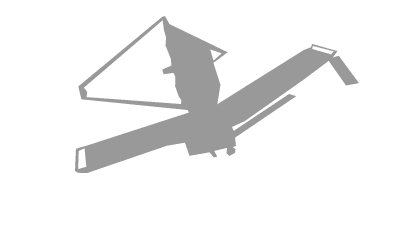
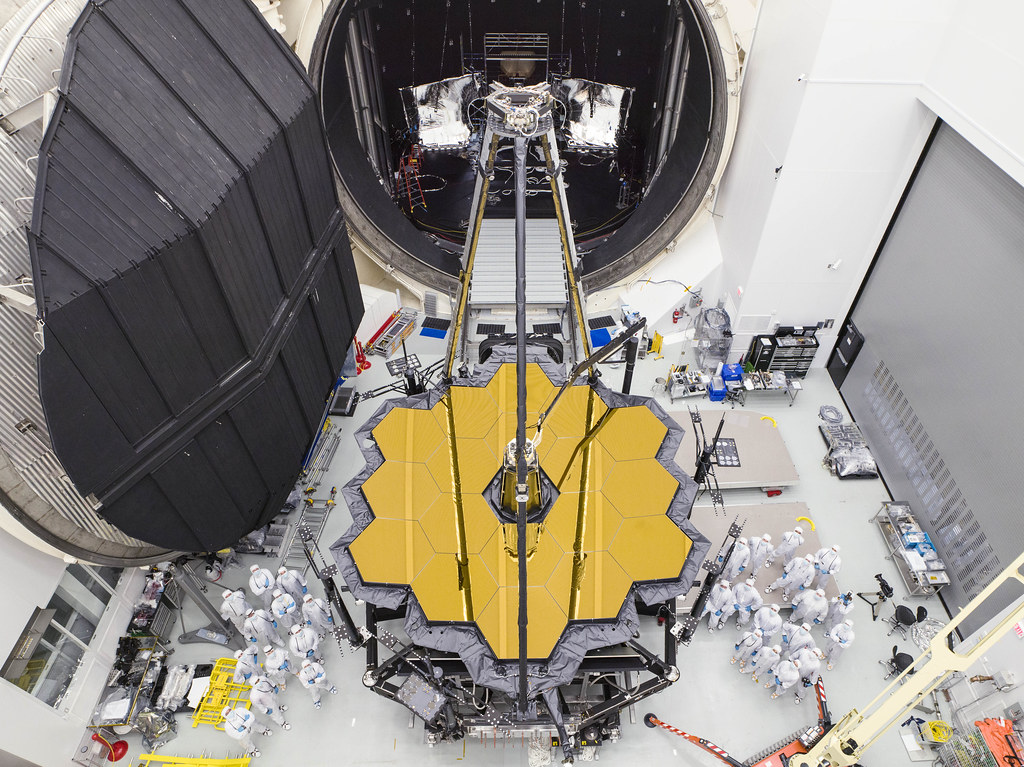
The Optical Telescope Element (OTE) is the eye of the James Webb Space Telescope Observatory. The OTE gathers the light coming from space and provides it to the science instruments. Webb needs a large mirror to collect as much light as possible to see galaxies from the beginning of the Universe. Webb scientists and engineers have determined that a primary mirror 6.5 meters (21.3 feet) across is what was needed to measure the light from these galaxies.

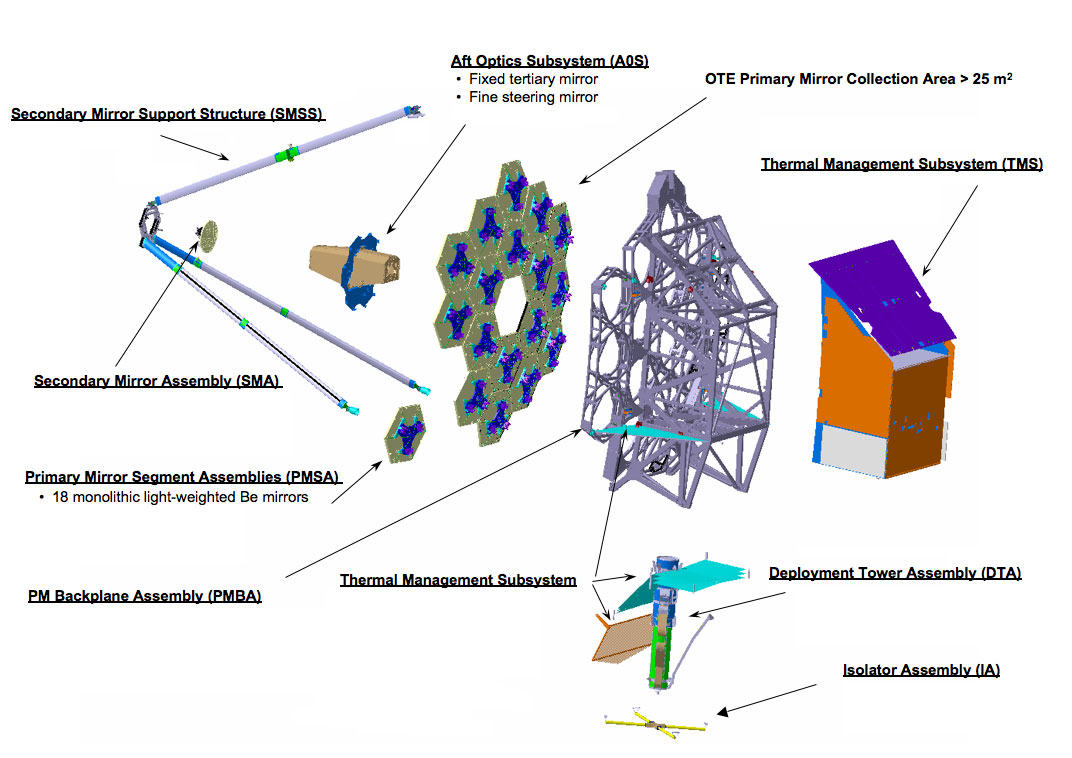
OTE diagram

The OTE has 2 other components: the Fine Steering Mirror (FSM); and the structural pieces to hold everything together. The structural pieces include [the secondary mirror support structure (SMSS) and the primary mirror backplane assembly.

The OTE tertiary mirror and the fine steering mirror are both contained within an OTE subsystem known as the Aft Optics Subsystem. The backplane, in addition to holding the OTE together will be where the science instrument, in the Integrated Science Instrument Module (ISIM), is installed in the Observatory.


Scope It Out Learn more about the different parts of JWST, and compare it to a simple telescope by playing our "Scope It Out" game!


More About Webb's Primary Mirror

No launch vehicle (rocket) is large enough to hold a 6.5-meter mirror if it was all one piece. The Webb team decided to build the mirror with 18 hexagonal primary mirror assembly segments, which can be folded up to fit into the launch vehicle and then unfold after launch.

This animation shows how the Webb can fold up to fit in the launch vehicle.

This animation shows the Webb unfolding and deploying in space.

So that the segments work together as a single large mirror, the 18 segments have been divided into 3 groups of six mirrors, each group having a slightly different shape (prescription). A system known as Wavefront Sensing & Control has been developed, as well. The image at right shows the location of the different mirrors within the primary mirror.

JWST mirror assembly segment

JWST and Hubble mirror comparison

In addition to making the mirror small enough to fit into a rocket, the Webb team also has to make it light enough to be launched. If the Hubble Space Telescope's mirror (2.4 meters) was scaled to be large enough for Webb, it would be too heavy to launch into orbit. The Webb team had to find new ways to build the mirror so that it would be light enough. Read more about Webb's mirrors...

Spacer
NASA Home 
Page ESA Home 
Page CSA Home 
Page

Webmaster: Maggie Masetti

Responsible NASA Official: John Durning

+Privacy Policy and Important Notices

Spacer
Spacer Spacer Spacer