JWST orbits the sun, a million miles away from Earth at the second Lagrange point.

Webb Orbit
A Solar Orbit
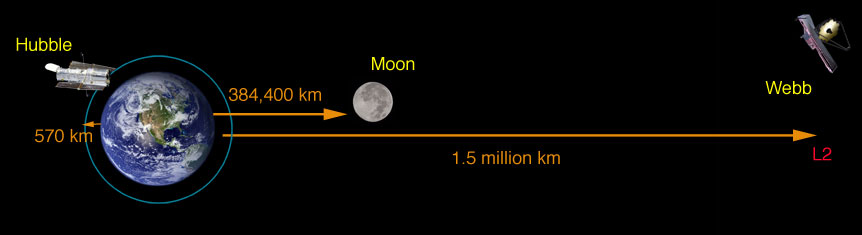
The James Webb Space Telescope is not in orbit around the Earth, like the Hubble Space Telescope is - it actually orbits the Sun, 1.5 million kilometers (1 million miles) away from the Earth at what is called the second Lagrange point or L2. What is special about this orbit is that it lets the telescope stay in line with the Earth as it moves around the Sun. This allows the satellite's large sunshield to protect the telescope from the light and heat of the Sun and Earth (and Moon).

Animation of Webb's Orbit
Why Does the Direction of the Earth and Sun Matter?
Webb primarily observes infrared light, which can sometimes be felt as heat. Because the telescope observes the very faint infrared signals of very distant objects, it needs to be shielded from any bright, hot sources. This also includes the satellite itself! The sunshield serves to separate the sensitive mirrors and instruments from not only the Sun and Earth/Moon, but also the spacecraft bus.
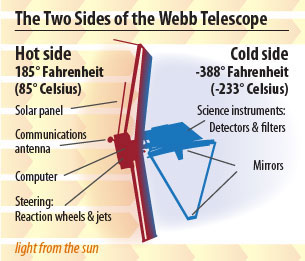
The telescope itself operates at about 225 degrees below zero Celsius (minus 370 Fahrenheit). The temperature difference between the hot and cold sides of the telescope is huge - you could almost boil water on the hot side, and freeze nitrogen on the cold side!
To have the sunshield be effective protection (it gives the telescope the equivalent of SPF one million sunscreen) against the light and heat of the Sun/Earth/Moon, these bodies all have to be located in the same direction.
This is why the telescope is out at the second Lagrange point.
What is L2?
Joseph-Louis Lagrange was an 18th century mathematician who found the solution to what is called the “three-body problem.” That is, is there any stable configuration, in which three bodies could orbit each other, yet stay in the same position relative to each other? As it turns out, there are five solutions to this problem - and they are called the five Lagrange points, after their discoverer. At Lagrange points, the gravitational pull of two large masses precisely equals the centripetal force required for a small object to move with them. The L1, L2, and L3 points are all in line with each other - and L4 and L5 are at the points of equilateral triangles.
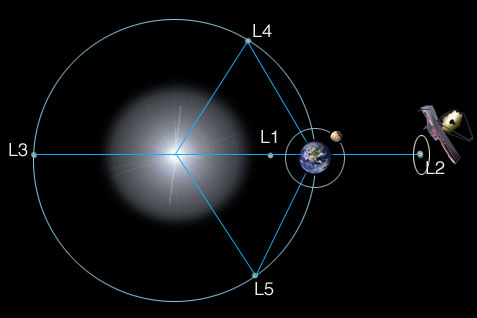
The first Sun-Earth Lagrange point, L1, is 1.5 million km from the Earth towards the Sun, and there have been many solar observatories located here, including DSCOVR, WIND, SOHO, and ACE.
There have been other satellites out at Sun-Earth L2, where Webb is, including WMAP, Herschel, and Planck.
Some Technical Details: It is easy for an object (like a spacecraft) at one of these five points to stay in place relative to the other two bodies (e.g., the Sun and the Earth). In fact, L4 and L5 are stable in that objects there will orbit L4 and L5 with no assistance. Some small asteroids are known to be orbiting the Sun-Earth L4 and L5 points. However, L1, L2, and L3 are metastable so objects around these points slowly drift away into their own orbits around the Sun unless they maintain their positions, for example by using small periodic rocket thrust. This is why L1, L2, and L3 don't "collect" objects like L4 and L5 do.
Webb at L2
If Webb is orbiting the Sun further out than Earth, shouldn't it take more than a year to orbit the Sun? Normally yes, but the balance of the combined gravitational pull of the Sun and the Earth at the L2 point means that Webb keeps up with the Earth as it goes around the Sun. The gravitational forces of the Sun and the Earth can nearly hold a spacecraft at this point, so that it takes relatively little rocket thrust to keep the spacecraft in orbit around L2.
Webb orbits around L2; it does not sit stationary precisely at L2. Webb's orbit is represented in this screenshot from our deployment video (below), roughly to scale; it is actually similar in size to the Moon's orbit around the Earth! This orbit (which takes Webb about 6 months to complete once) keeps the telescope out of the shadows of both the Earth and Moon. Unlike Hubble, which goes in and out of Earth shadow every 90 minutes, Webb has an unimpeded view that allows science operations 24/7.
Communicating with Webb
Webb's position out at L2 also makes it easy for us to talk to it. Since it is always at the same location relative to Earth-in the midnight sky about 1.5 million km away - we can have continuous communications with it as the Earth rotates through the Deep Space Network (DSN), using three large antennas on the ground located in Australia, Spain and California. During routine operations, Webb uplinks command sequences and downlinks data up to twice per day, through the DSN. The observatory can perform a sequence of commands (pointing and observations) autonomously. Typically, the Space Telescope Science Institute uploads a full week's worth of commands at a time, and makes updates daily as needed.
How long did it take Webb to get to L2?
It took roughly 30 days for Webb to reach the start of its orbit at L2, but it took only 3 days to get as far away as the Moon’s orbit, which is about a quarter of the way there. Getting Webb to its orbit around L2 is like reaching the top of a hill by pedaling a bicycle vigorously only at the very beginning of the climb, generating enough energy and speed to spend most of the way coasting up the hill so as to slow to a stop and barely arrive at the top.
Timeline of Events After Launch:
- In the first hour: The ride to space, solar array deployment, and “free flight.” The Ariane 5 launch vehicle provided thrust for roughly 26 minutes after a morning liftoff from French Guiana. Moments after second stage engine cut-off, Webb separated from the Ariane, which triggered the solar array to deploy within minutes so that Webb could start making electricity from sunshine and stop draining its battery. Webb quickly established its ability to orient itself and “fly” in space.
- In the first day: Mid-course correction to L2. Ariane sent Webb on a direct route to L2, without first orbiting Earth. During the first day, we executed the first and most important trajectory correction maneuver using small rocket engines aboard Webb itself. We also released and deployed the high gain antenna to enable the highest available rates of data communication as early as practical.
- In the first week: Sunshield deployment. Shortly after we executed a second trajectory correction maneuver, we started the sequence of major deployments, beginning with the fore and aft sunshield pallets. The next step was separation of the spacecraft bus and telescope by extending the telescoping tower between them. The tower extended about 2 meters, which was necessary at this point in the sequence so that the rest of the sunshield deployment could proceed. Next, the sunshield membranes were unpinned and the telescoping sunshield midbooms were extended – first the port side and then the starboard side – pulling the membranes out with them. The last sunshield deployment step was the tensioning of the membranes. In the meantime, other things like radiators were released and deployed.
- In the first month: Telescope deployment, cooldown, instrument turn-on, and insertion into orbit around L2. During the second week after launch, we finished deploying the telescope structures by unfolding and latching the secondary mirror tripod and rotating and latching the two primary mirror wings. Note that the telescope and scientific instruments started to cool rapidly in the shade of the sunshield, but it took several weeks for them to cool all the way down and reach stable temperatures. This cooldown was carefully controlled with strategically-placed electric heater strips so that everything shrinks carefully and so that water trapped inside parts of the observatory can escape as gas to the vacuum of space and not freeze as ice onto mirrors or detectors, which would degrade scientific performance. We unlocked all the primary mirror segments and the secondary mirror and verified that we can move them. Near the end of the first month, we executed the last mid-course maneuver to insert into the optimum orbit around L2. During this time we also powered-up the scientific instrument systems. The remaining five months of commissioning were all about aligning the optics and calibrating the scientific instruments.
- In the second, third and fourth months: Initial optics checkouts, and telescope alignment. Using the Fine Guidance Sensor, we pointed Webb at a single bright star and demonstrated that the observatory could acquire and lock onto targets, and we took data mainly with NIRCam. But because the primary mirror segments had yet to be aligned to work as a single mirror, there were distorted images of the same single target star. We then embarked on the long process of aligning all the telescope optics, beginning with identifying which primary mirror segment went with which image by moving each segment one at a time and ended a few months later with all the segments aligned as one and the secondary mirror aligned optimally. Cooldown effectively ended and the cryocooler started running at its lowest temperature and MIRI started taking good data too.
- In the fifth and sixth months: Calibration and completion of commissioning. We meticulously calibrated all of the scientific instruments’ many modes of operation while observing representative targets, and we demonstrated the ability to track “moving” targets, which were nearby objects like asteroids, comets, moons, and planets in our own solar system. We made “Early Release Observations,” to be revealed right after commissioning was over, that showcased the capabilities of the observatory.
- After six months: “Science operations!” Webb began its science mission and started to conduct routine science operations.


